Minimal Invasive Foot and Ankle Surgery

Dr. Stephen A. Isham and Associates

HomeClinicProceduresCurriculum VitaeLinksContact En Español
Reverdin-IshamIsham BunionetteIsham Hammertoe ProceduresHallux Valgus 
AboutClassificationProcedureOperationAdvantages/DisadvantagesResultsSummary/References 
 

The Reverdin-lsham Procedure for the Correction of Hallux Abductio Valgus

Classification

Classification of deformities is an instrument that enables the podiatric surgeon to select or modify a procedure to achieve the best results for each patient. It is important that we realize that surgery is an art, and we must treat the patient as a whole and not as a set of radiographs and a collection of angles and measurements. To class)* the severity of a bunion deformity, the following measurements are most commonly used by the author: hallus abductus angle, distal articular set angle, proximal articular set angle, first intermetatarsal angle, and first metatarsophalangeal joint position.

Hallux Abductus Angle
The hallux abductus angle (HA angle) is formed by the bisection of the longitudinal axis of the first proximal phalanx and the longitudinal axis of the first metatarsal. The normal angle formed by these lines is between 5° and 15°.
Distal Articular Set Angle
The distal articular set angle (DASA) is formed by the bisection of the longitudinal axis of the proximal phalanx and the line drawn perpendicular to the articular surface of the base of the proximal phalanx.
Proximal Articular Set Angle
The proximal articular set angle (PASA) is formed by the bisection of the longitudinal axis of the first metatarsal and the active cartilage of the head of the first metatarsal.
First Intermetatarsal Angle
The first intermetatarsal angle is formed by the bisection of the line of the longitudinal axis of the first and second metatarsals. Normal range is between 6° and 8°.
First Metatarsophalangeal Joint Position

The first metatarsophalangeal joint (M PJ) position has three components

  1. Congruous--The articular surface of the first M PJ is parallel or equal.
  2. Deviated--The articular surface of the first M PJ is unequal. The lines of intersection fall outside the joint.
  3. Subluxed--The articular surface of the first M PJ is unequal with lines of intersection intersecting inside of the M PJ.

The presence of a deviated or subluxed joint position is evidence of the presence of increased positional deformity.


Classification of Hallux Abductio Valgus

The classification of hallux abducto valgus is divided into three classes: mild, moderate, and severe.

Mild Hallux Abducto Valgus

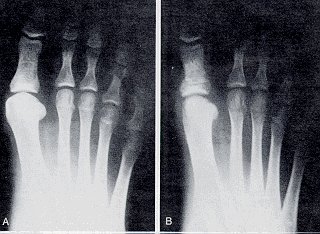
Deformity of hallux abducto valgus has a hallux abductus angle of 5° to 20°, and a first intermetatarsal angle of 6° to 8°. In mild hallux abducto valgus deformities, the joint surface is generally congruous (Fig. 1).

Figure 1

An example of mild HAV deformity.

  1. Preoperative view.
  2. The same patient one year after surgery.

Moderate Hallux Abducto Valgus

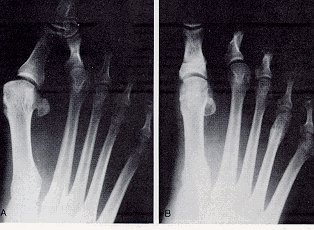
Deformities of moderate abducto valgus have a hallux abductus angle between 20° and 40° and a first intermetatarsal angle of 8° to 15°. In moderate hallux abducto valgus cases, the first MPJ position is generally deviated (Fig. 2).

Figure 2

An example of a moderate HAV deformity

  1. The preoperative radiograph.
  2. The same patient 3 years after surgery.

Severe Hallux Abductio Valgus

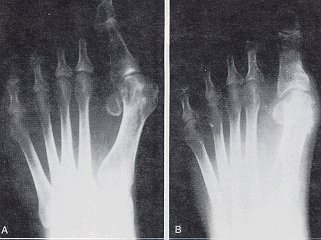
Deformities of severe hallux abducto valgus contain a hallux abductus angle of 40° or greater. The first intermetatarsal angle is 15° or greater, and generally in severe HAV, the joint position is usually subluxed (Fig. 3).

Figure 3

An example of a severe HAV deformity.

  1. The preoperative radiograph.
  2. The same patient 5 years after surgery.

[ previous ] [ next ]

 
Site content © 1997-2007 Coeur d'Alene Foot & Ankle Clinic.
Site design and implementation by Studio 505.